Satellite News

Just another satellite weblog

Archive for July 16th, 2026

Post-ignition anomaly causes abort of SpaceX’s Starship Flight 13

July 16th, 2026 by me
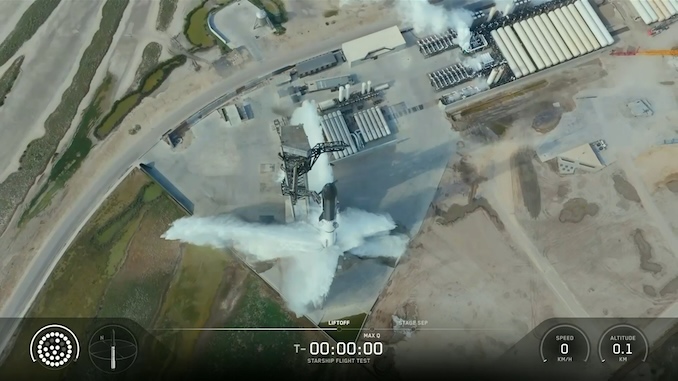
SpaceX experienced a last-second abort during the launch attempt of Starship Flight 13 on July 16, 2026. On-screen telemetry data showed four engines on the Super Heavy booster didn’t ignite as planned, which SpaceX founder Elon Musk said triggered an abort. Image: SpaceX via livestream

Update July 16, 7:10 p.m. EDT (2310 UTC): SpaceX aborted the mission following an apparent engine issue.

SpaceX will have to wait debut its long-promised Starlink Version 3 satellites after an apparent engine issue forced a last second abort of the suborbital test mission

The Starship Flight 13 mission will be the second launch of a third-generation Starship-Super Heavy launch vehicle and the second mission for the program this year.

SpaceX reached ignition of the Super Heavy booster at the Pad 2 at SpaceX’s Starbase facilities in southern Texas at 5:45 p.m. CDT (6:45 p.m. EDT / 2245 UTC), but on-screen telemetry data showed four engines that apparently didn’t ignite as anticipated.

“Some of the engines didn’t start, triggering an automatic launch abort,” SpaceX founder Elon Musk wrote on his social media site, X, about 10 minutes after the abort. “Next launch attempt hopefully in a few days.”

When it flies, SpaceX will launch this mission using Booster 20 and the Ship 40 upper stage. Both stages are flying for the first time and SpaceX will not attempt to recover either for reuse.

One of the biggest differences between Flight 13 and Flight 12, which launched in May, is that this time around, SpaceX will be deploying 20 production Starlink V3 satellites. While they’re not going into orbit, SpaceX does intend to briefly link them to the broader network in low Earth orbit.

“As part of this initial test, Starship is planned to deploy 20 satellites which will extend solar arrays and antennas and will attempt to connect with the larger Starlink constellation via high-capacity lasers,” SpaceX wrote prior to launch. “The Starlink satellites will be on the same suborbital trajectory as Starship and are expected to demise upon reentry approximately 20 minutes after deployment.”

Other mission objectives are fairly similar to what was demonstrated in Flight 12. Those include a relight of a Raptor engine on the upper stage during the coast phase and performing a controlled landing of the booster in the Gulf of Mexico. Neither of those objectives were able to be accomplished back in May.

SpaceX said the startup sequence of the engines on Ship 39 “caused the directional flip of the booster to be off by approximately 90 degrees.” That coupled with issues with five out of 33 sea-level engines on the booster prevented a nominal boostback burn and Booster 19 was lost prematurely.
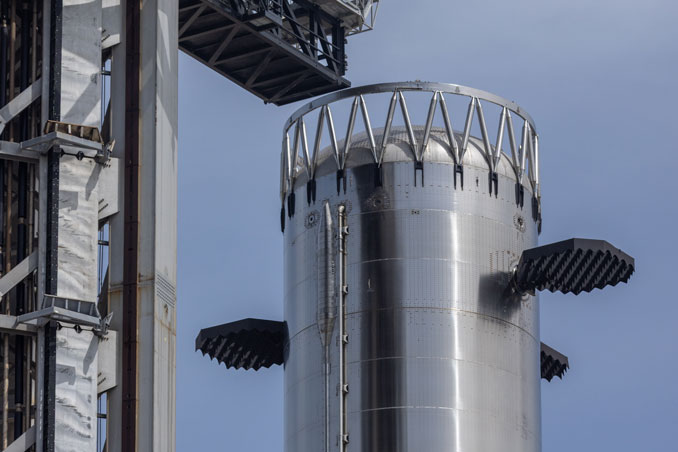
Super Heavy Booster 20 stands ready to receive the Ship upper stage ahead of the 13th test flight of SpaceX’s Starship vehicle. Image: Adam Bernstein/Spaceflight Now.

“The Super Heavy on this upcoming flight has hardware modifications to improve re-light reliability along with updates to engine alarms and aborts to match the conditions seen in the multi-engine flight environment,” the company wrote.

In between these two flights of Starship Version 3, SpaceX said it also made “several hardware an operational modifications” to address issues that caused one of the three Raptor Vacuum engines to go offline less than a minute after stage separation.

SpaceX is also continuing its heat shield iterative work in order to produce a protective system that will eventually allow for rapid reuse of the upper stage.

“Multiple tiles will be attached to the metallic side of Starship’s aft flaps along with modified tiles and attachment mechanisms in the heat shield covering the aft skirt to gather flight data on different attachment options,” SpaceX said. “Finally, Starship’s heat shield will have load sensing tiles to take measurements as the vehicle experiences higher dynamic pressure on ascent than previous flights, putting added stress on the tile attachments in exchange for increased payload to orbit capability.”

Gwynne Shotwell, SpaceX’s president and chief operating officer, told CNBC in an interview in June that the company may attempt to perform an orbital launch as soon as Flight 14, depending on how this next mission goes. She said a monthly launch cadence is the company’s target.
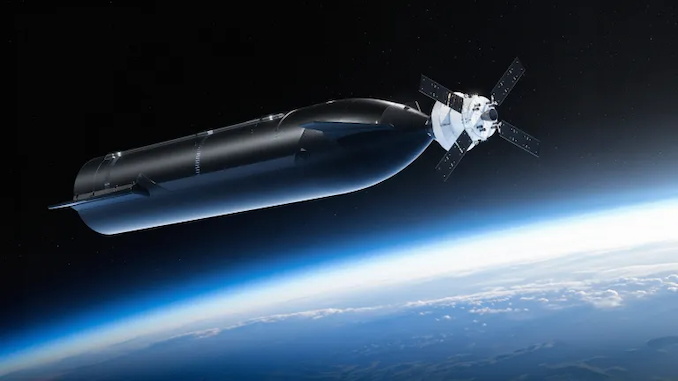
An artist’s concept of NASA’s Orion spacecraft docking in low Earth orbit with SpaceX’s Starship Version 3 rocket with a docking adaptor during the Artemis 3 mission. Rendering: SpaceX

Rapid learning will be critical as NASA is relying on SpaceX to get Starship to orbit sooner rather than later. A modified version of a Starship Version 3 rocket with a docking adaptor is scheduled to fly next years part of the Artemis 3 mission.

Unlike Blue Origin’s Blue Moon Mark 2 Alpha spacecraft, the Artemis 3 crew will not enter into Starship on that flight, but rather NASA and SpaceX will focus on testing the interaction of these two vehicles when they dock.

“Software testing between spacecrafts will help demonstrate that the commercial human landing system prototypes and Orion can meet at a precise time and location in space,” NASA said in a press release on Wednesday. “When Orion docks with the Blue Moon test lander, the Orion spacecraft’s software will control the docked spacecraft. Meanwhile, the SpaceX test article will control the docked spacecraft for the second portion of the mission.”

Flight 13 is also SpaceX’s first mission for the Starship program since it became a publicly traded company on the Nasdaq. The company’s new investors will be keenly watching the performance of the launcher and launch infrastructure as SpaceX hopes to begin deploying orbital payloads later this year.

Category: NEWS | No Comments »
SpaceX launches 21 communications satellites for the Space Development Agency

July 16th, 2026 by me

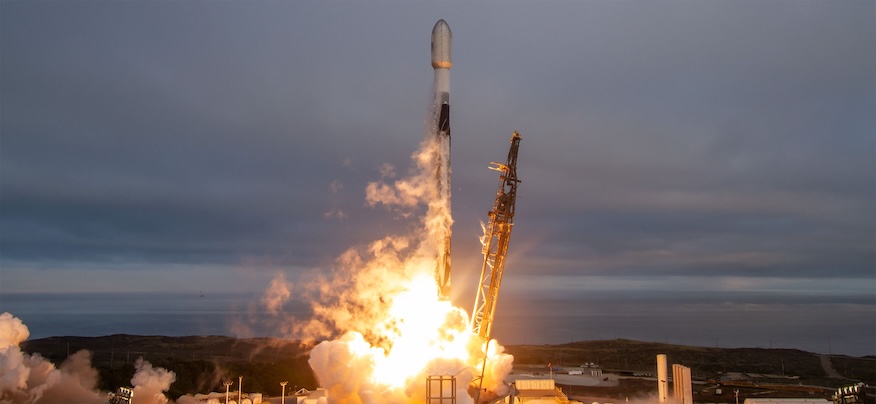
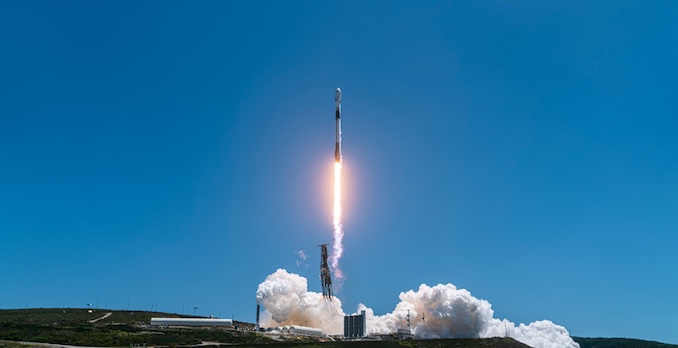
A SpaceX Falcon 9 rocket lifts off from Space Launch Complex 4 East at Vandenberg Space Force Base to send 21 satellites from York Space Systems to orbit on behalf of the Space Development Agency. Image: SpaceX

Update July 16, 8 p.m. EDT (0000 UTC): The Space Development Agency confirms a successful deployment.

The Space Development Agency launched its third batch of operational satellites designed to improve secure communications between members of the U.S. military and its allies across the globe aboard a Falcon 9 rocket from California on Thursday.

The SDA’s constellation, the Proliferated Warfighter Space Architecture (PWSA), consists of a series of series of interconnected satellites with varying focuses, from missile tracking to navigation. The satellites launching on Thursday afternoon are part of the communications layer, referred to as the Tranche 1 Transport Layer (T1TL).

Liftoff of SpaceX’s Falcon 9 rocket from Space Launch Complex 4 East (SLC-4E) at Vandenberg Space Force Base happened at 1:32 p.m. PDT (4:32 p.m. EDT / 2032 UTC).

“The National Security Space Launch (NSSL) program team successfully executed a launch today for our Space Development Agency partners, helping build out another orbital plane for their data Transport Layer,” said U.S. Space Force Col. Ryan Hiserote, SSC SYD 80 commander, in a statement. “We look forward to continuing our close partnership to deliver additional Tranche 1 and 2 missions for SDA over the next two years as part of NSSL’s continued delivery of responsive and reliable launch for our nation.”

?

SpaceX launched the T1TL-E mission using the Falcon 9 first stage booster B1103, making its fourth flight after previously launching Starlink 17-35, Starlink 17-42, and NROL-179.

A little more than 8.5 minutes after liftoff, B1103 landed on the SpaceX droneship, ‘Of Course I Still Love You’, positioned in the Pacific Ocean. This was the 211th landing on this vessel and the 639th booster landing to date for SpaceX.

Building out the Transport Layer

There will be 154 operational satellites spread across the various layers of the Tranche 1 portion of SDA’s PWSA constellation. That breaks down to the following, according the SDA:

  • 126 Transport Layer satellites
  • 28 Tracking Layer satellites
  • 4 missile defense demonstration satellites

These satellites will be managed from Space Operations Centers located at the Grand Forks Air Force Base in North Dakota and Redstone Arsenal in Alabama.

The SDA awarded satellite construction contracts to Lockheed Martin Space, Northrop Grumman Strategic Space Systems and York Space Systems in February 2022 to build the satellites for the T1TL portion of the constellation.

The first 21 T1TL satellites from York Space Systems launched on the T1TL-B mission on Sept. 10, 2025. That was followed by the T1TL-C mission a month later with satellites from Lockheed Martin.

A SpaceX Falcon 9 rocket lifts off from Space Launch Complex 4 East at Vandenberg Space Force Base on Sept. 10, 2025. It carried 21 satellites for the Space Development Agency’s Tranche 1 Transport Layer, part of the larger Proliferated Warfighter Space Architecture, a low Earth orbit satellite constellation. Image: SpaceX

In a September 2025 statement to Spaceflight Now, Col. Ryan Hiserote, the U.S. Space Force’s Space Systems Command’s (SSC) division chief in System Delta 80 Assured Access to Space, said that the order of the first three missions for the SDA’s T1TL were “interchangeable” and didn’t need to fly in alphabetical order.

“York was the first of the Tranche 1 performers to ship and launch its satellites. All spacecraft from York’s first production lot were confirmed healthy within hours of launch separation, and the constellation has since passed numerous milestones as it continues through early operations,” the company said in a June 5 press release.

“With this second production lot, York is again first among Tranche 1 primes to complete T1 spacecraft production, continuing to demonstrate the high-rate production capabilities required to support proliferated space architectures. Upon full delivery, York’s first and second production lots represent more than 40 spacecraft developed in support of the proliferated mission.”

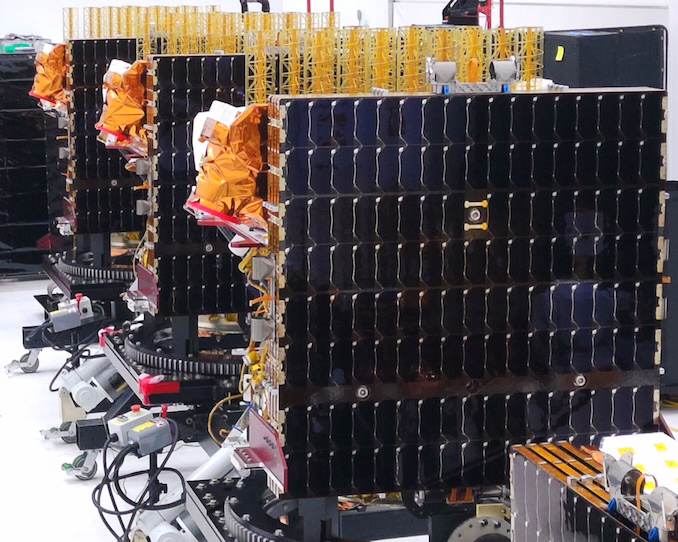
Three of the 21 satellites from York Space Systems inside a clean room at Vandenberg Space Force Base prior to the launch of the Space Development Agency’s Trance 1 Transport Layer E mission on a SpaceX Falcon 9 rocket. Image: York Space Systems

Launch of the T1TL-E mission was awarded to SpaceX as part of fourth order year of missions within the National Security Space Launch (NSSL) Phase 2 contract, which is managed by Space Systems Command. Announced in June 2023, T1TL-E was one of six missions awarded to SpaceX.

When awarded, these missions were scheduled to launch in fiscal year 2025. However, as happens with a number of NSSL missions, the payloads can be years behind schedule.

The February 2022 press release from the SDA announcing the awards for the T1TL missions stated that these satellites should be “ready for launch by September 2024.” However, the first batch didn’t fly until a year later.

Spaceflight Now reached out to the SDA to learn more about why none of the satellites manufactured by Northrop Grumman have launched to date, but we did not receive a response before publishing this article.

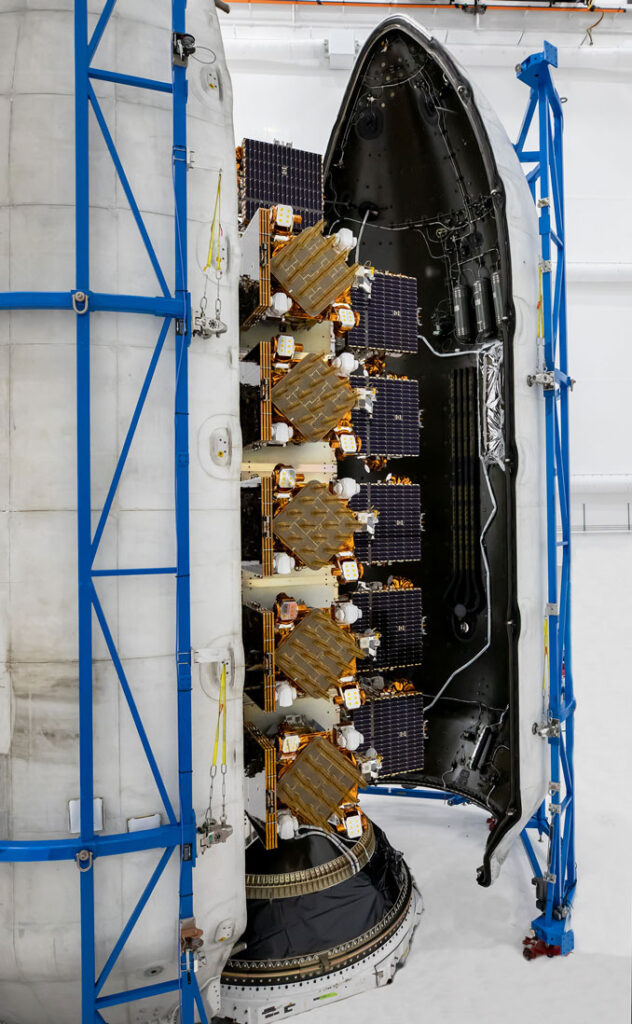
A batch of 21 satellites manufactured by York Space Systems are prepared for encapsulation in a SpaceX Falcon 9 payload fairing ahead of launching the Space Development Agency’s Tranche 1 Transport Layer E (T1TL-E) mission. Image: SpaceX

Category: NEWS | No Comments »

SpaceX launches 21 communications satellites for the Space Development Agency

July 16th, 2026 by me

A SpaceX Falcon 9 rocket lifts off from Space Launch Complex 4 East at Vandenberg Space Force Base to send 21 satellites from York Space Systems to orbit on behalf of the Space Development Agency. Image: SpaceX

Update July 16, 8 p.m. EDT (0000 UTC): The Space Development Agency confirms a successful deployment.

The Space Development Agency launched its third batch of operational satellites designed to improve secure communications between members of the U.S. military and its allies across the globe aboard a Falcon 9 rocket from California on Thursday.

The SDA’s constellation, the Proliferated Warfighter Space Architecture (PWSA), consists of a series of series of interconnected satellites with varying focuses, from missile tracking to navigation. The satellites launching on Thursday afternoon are part of the communications layer, referred to as the Tranche 1 Transport Layer (T1TL).

Liftoff of SpaceX’s Falcon 9 rocket from Space Launch Complex 4 East (SLC-4E) at Vandenberg Space Force Base happened at 1:32 p.m. PDT (4:32 p.m. EDT / 2032 UTC).

“The National Security Space Launch (NSSL) program team successfully executed a launch today for our Space Development Agency partners, helping build out another orbital plane for their data Transport Layer,” said U.S. Space Force Col. Ryan Hiserote, SSC SYD 80 commander, in a statement. “We look forward to continuing our close partnership to deliver additional Tranche 1 and 2 missions for SDA over the next two years as part of NSSL’s continued delivery of responsive and reliable launch for our nation.”

?

SpaceX launched the T1TL-E mission using the Falcon 9 first stage booster B1103, making its fourth flight after previously launching Starlink 17-35, Starlink 17-42, and NROL-179.

A little more than 8.5 minutes after liftoff, B1103 landed on the SpaceX droneship, ‘Of Course I Still Love You’, positioned in the Pacific Ocean. This was the 211th landing on this vessel and the 639th booster landing to date for SpaceX.

Building out the Transport Layer

There will be 154 operational satellites spread across the various layers of the Tranche 1 portion of SDA’s PWSA constellation. That breaks down to the following, according the SDA:

  • 126 Transport Layer satellites
  • 28 Tracking Layer satellites
  • 4 missile defense demonstration satellites

These satellites will be managed from Space Operations Centers located at the Grand Forks Air Force Base in North Dakota and Redstone Arsenal in Alabama.

The SDA awarded satellite construction contracts to Lockheed Martin Space, Northrop Grumman Strategic Space Systems and York Space Systems in February 2022 to build the satellites for the T1TL portion of the constellation.

The first 21 T1TL satellites from York Space Systems launched on the T1TL-B mission on Sept. 10, 2025. That was followed by the T1TL-C mission a month later with satellites from Lockheed Martin.

A SpaceX Falcon 9 rocket lifts off from Space Launch Complex 4 East at Vandenberg Space Force Base on Sept. 10, 2025. It carried 21 satellites for the Space Development Agency’s Tranche 1 Transport Layer, part of the larger Proliferated Warfighter Space Architecture, a low Earth orbit satellite constellation. Image: SpaceX

In a September 2025 statement to Spaceflight Now, Col. Ryan Hiserote, the U.S. Space Force’s Space Systems Command’s (SSC) division chief in System Delta 80 Assured Access to Space, said that the order of the first three missions for the SDA’s T1TL were “interchangeable” and didn’t need to fly in alphabetical order.

“York was the first of the Tranche 1 performers to ship and launch its satellites. All spacecraft from York’s first production lot were confirmed healthy within hours of launch separation, and the constellation has since passed numerous milestones as it continues through early operations,” the company said in a June 5 press release.

“With this second production lot, York is again first among Tranche 1 primes to complete T1 spacecraft production, continuing to demonstrate the high-rate production capabilities required to support proliferated space architectures. Upon full delivery, York’s first and second production lots represent more than 40 spacecraft developed in support of the proliferated mission.”

Three of the 21 satellites from York Space Systems inside a clean room at Vandenberg Space Force Base prior to the launch of the Space Development Agency’s Trance 1 Transport Layer E mission on a SpaceX Falcon 9 rocket. Image: York Space Systems

Launch of the T1TL-E mission was awarded to SpaceX as part of fourth order year of missions within the National Security Space Launch (NSSL) Phase 2 contract, which is managed by Space Systems Command. Announced in June 2023, T1TL-E was one of six missions awarded to SpaceX.

When awarded, these missions were scheduled to launch in fiscal year 2025. However, as happens with a number of NSSL missions, the payloads can be years behind schedule.

The February 2022 press release from the SDA announcing the awards for the T1TL missions stated that these satellites should be “ready for launch by September 2024.” However, the first batch didn’t fly until a year later.

Spaceflight Now reached out to the SDA to learn more about why none of the satellites manufactured by Northrop Grumman have launched to date, but we did not receive a response before publishing this article.

A batch of 21 satellites manufactured by York Space Systems are prepared for encapsulation in a SpaceX Falcon 9 payload fairing ahead of launching the Space Development Agency’s Tranche 1 Transport Layer E (T1TL-E) mission. Image: SpaceX

Category: NEWS | No Comments »

Satellite News
Privacy Overview

This website uses cookies so that we can provide you with the best user experience possible. Cookie information is stored in your browser and performs functions such as recognising you when you return to our website and helping our team to understand which sections of the website you find most interesting and useful.